AI Character Consistency Without LoRA: How to Keep the Same Character Across Every Scene
If you've generated AI art of the same character across multiple scenes, you've probably run into this: the prompt is identical, but somehow the face, hairstyle, or outfit details drift from one image to the next. It's common enough that among illustrators and manga artists experimenting with AI, "character consistency" gets called one of the biggest walls in AI-assisted comics.
This article breaks down why character consistency breaks down in AI image generation, looks at the limits of the usual fixes — careful prompting and LoRA training — and walks through how Ktlyst lets you keep a character consistent just by arranging reference images, with you still doing the creative work.
Why AI-generated characters drift from scene to scene
The same prompt, a slightly different person each time
Even when you spell out details like "silver hair, red eyes, kimono," the balance of a face or the nuance of an expression can shift with every generation. That's because a prompt is only ever a verbal approximation — it's hard to pin down exactly how a strand of hair falls or how an eye catches the light through words alone.
The drift compounds as you add scenes
One image is easy enough to get away with, but generate a character across multiple scenes and poses and that drift starts to stack up. You end up liking the character sheet, only to find the character looks like someone else entirely by the time you get to the next panel.
The usual fixes for consistency, and where they fall short
Refining the prompt
Spelling out details more precisely, and tweaking seed values or word order, does improve reproducibility somewhat. But things like hairstyle or expression nuance are hard to put into words in the first place, and every small adjustment means revisiting the whole prompt again.
Training a LoRA for the character
A character-specific LoRA (a small fine-tuned model) can reproduce that character with high fidelity. But getting there means collecting dozens of training images, setting up a training environment (GPU access, the right tooling), and tuning parameters — none of it a low bar. Repeating that process every time you dream up a new character is a real burden, especially for artists working solo.
Using reference images as an image prompt
Feeding an image itself as the "example," instead of text, has been gaining traction. The catch: wiring this up in a node-based tool like ComfyUI means loading models, connecting several nodes, and tuning parameters — enough of a setup that plenty of artists without that technical background give up before they get anywhere.
Ktlyst: keep the character by just placing references in "Main"
Ktlyst turns the thing artists already do — collecting and arranging reference images — directly into the input for reproducing a character. No nodes, no technical vocabulary required. Ktlyst isn't built to generate finished art on its own; it's built for the ideation stage, where AI assists a human artist rather than replacing one. You're still the one choosing the references, judging the results, and deciding where the piece goes next.
Drop reference images of your character straight onto the canvas
On Ktlyst's canvas, you drag in images, GIFs, or frames pulled from video, the same way you already gather references in PureRef or a Pinterest board. There's no new workflow to learn.
Add several references, and the shared theme gets picked up automatically (Auto Essence Extraction)
Place several images of the same character together, and Ktlyst reads what they share — silhouette, color, mood — and carries it into the generations that follow. You don't have to spell out which features to preserve one by one; the "feel" of what you collected comes through on its own.
Reusable typed elements let a character outlive a single project
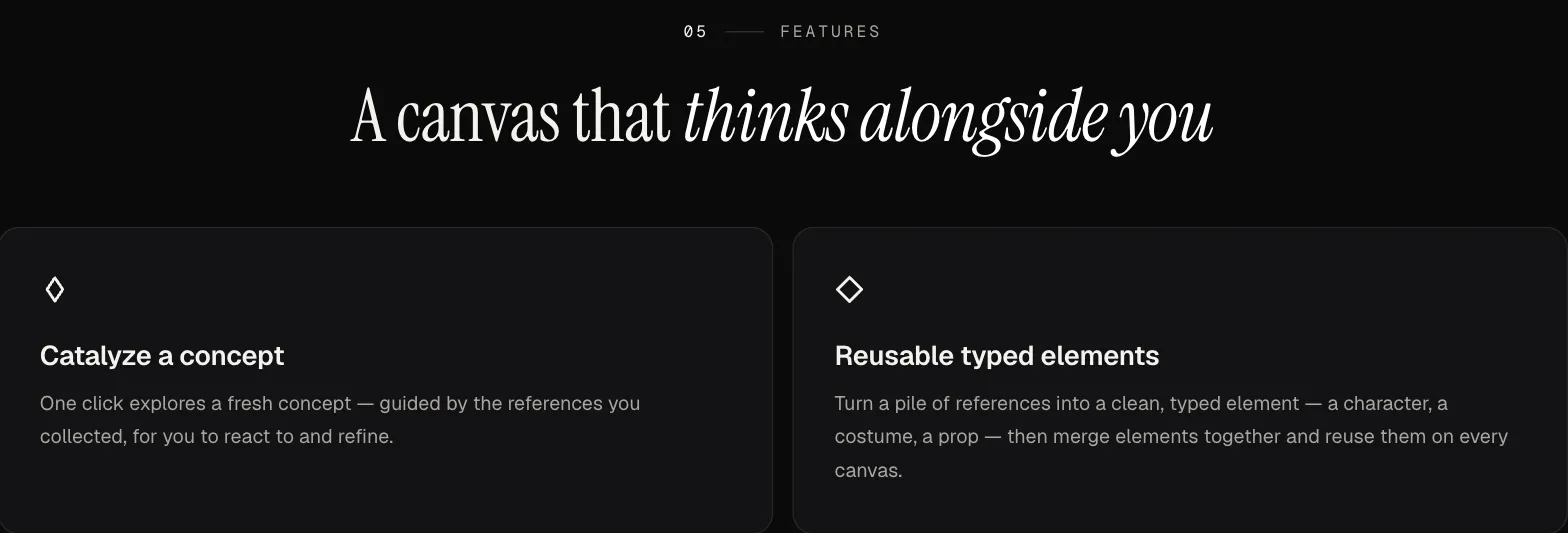
Ktlyst lets you fold a pile of references into a typed element — a character, a costume, a prop. Once a character exists as an element, you can pull it into any other canvas or scene without re-collecting references from scratch. Because every scene builds on the same element, consistency comes more naturally.
A separate Background role for swapping out the setting
You can assign character references to "Main" and setting or location references to "Background." Main answers "what to draw" (the character), Background answers "how it's arranged" (depth and composition) — so you can swap the backdrop while keeping the character intact.
How this compares to Midjourney and prompt-first tools
Midjourney, like most AI image tools before it, is built around text prompts as the starting point. Since output quality depends heavily on how well you can write, artists who don't naturally think in words tend to hit the character-consistency wall hardest — the image is vivid in their head, but hard to translate into a spell-like string of text.
Ktlyst moves that starting point from "put it into words" to "gather and arrange." If you want fine-grained control through a node graph, something like ComfyUI is still the right tool for that. What Ktlyst is aiming for is different: turning the reference-gathering artists already do into the instruction itself for reproducing a character — a starting point to react to and refine, not a finished decision made for you.
Takeaway
Character consistency in AI image generation isn't something prompt tweaks alone can fully solve, and LoRA training takes real preparation to get going. Ktlyst isn't positioning itself as a replacement for an artist's eye — it's a tool for the ideation stage, where AI helps you explore faster while you stay the one making the calls. Collecting a character's reference images into Main and saving them as an Element is enough to carry that same character into new compositions, scene after scene, with you steering the direction throughout. If you'd rather spend your time choosing, arranging, and looking at references than writing prompts, give it a try.
Ready to see it for yourself? Try Ktlyst free → — five canvases, 15 Catalyze runs a month, and one Pinterest board import, no credit card and no prompts to write.